

Welcome to Kweeklust garden park and the Boven IJ allotment garden trail, open from April to October.
The walking route connects six allotment gardens in Amsterdam-Noord: Buikslotermeer, Volendammerweg 305, Rust en Vreugd, Paterslaan 10, Kweeklust, Durgerdammerdijk 1, Tuinwijck, Liergouw 55, De Molen, Buitengouw 20, Wijkergouw, Wijkergouw 30. Each park has its own route description.
A total of six shorter walks are part of tuintrail.amsterdam.nl. You can start at any allotment garden park. Those who walk consecutively (approximately 12 kilometers) will return to the starting point. You can recognize the route by the blue-headed posts. THE ROUTE AT KWEEKLUST TAKES APPROX. 30 MINUTES. You can also download this route via the QR code at the blue beacon at the start of the route at Kweeklust (behind the iron gate). Some gardens have an "OPEN" sign; you are welcome to visit them. Enjoy your walk and our gardens!
NICE TO KNOW
Kweeklust Garden Park is open to the public from April to October. Besides the gardens, our park also features plenty of greenery, which is maintained by the gardeners. Workshops are organized, there's a public cuttings and supplies market every spring, we have a soup garden where Kweeklust gardeners grow vegetables and herbs in grow beds, and there's an annual open garden day. Keep an eye on our website for announcements.
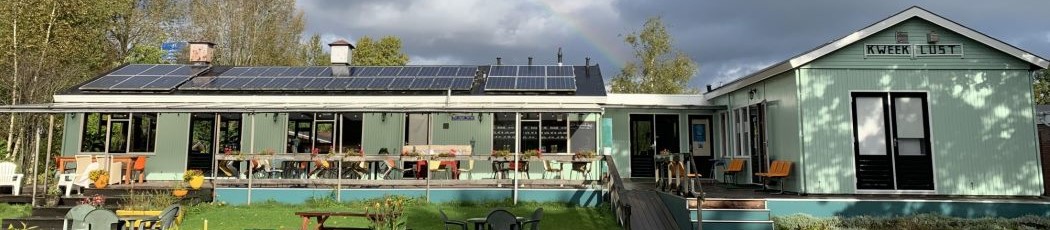
Kweeklust Garden Park was founded in 1936, in the midst of the Depression, in Nieuwendam. In the late 1950s, the park had to make way for urban expansion and was moved to the foot of the Schellingwouder Bridge. Due to the construction of the A10 ring road, Kweeklust had to relocate again, as the ring road was projected to cut right through it. The part within the ring road had to be removed. In 1985, the part outside the ring road was expanded, creating the garden park you're now walking through. Kweeklust has 103 gardens, ranging in size from 280 to 400 m², and is part of Amsterdam's ecological green structure. Perhaps when you arrived, you noticed a strip of boulders to the left of the entrance, along the canal outside the gate. This was created to promote the spreading of the grass snake (the IJ tot Gouw project). In the canteen meetings are held, darts are played, and football is watched, among other things). The gardens are usually clearly visible from the paths. At Kweeklust, we have moist peat soil that is naturally quite acidic. Therefore, you'll mainly find plants that prefer wet feet, although there are also pine trees. The park has an estimated 500 trees, both large and small, in 50 different species. During the walk, we'll point out a few specimens. Be amazed by all the trees and plants that thrive in marshy soil!
WALKING ROUTE
Right at the entrance to our park, you'll see on your left a monumental Canadian Poplar, part of a row along the ring road, which filters out a lot of particulate matter. On your right is a multi-stemmed American currant berry, whose fruit, after its beautiful spring blooms, is a treat for many birds. Walking along the access road, you'll see a maintenance workshop and a sand and soil storage facility for gardeners on your left. Continue on, keeping to the right. (p1) Past Reigerlaan, near the large round planter, find a path between the shrubs, where many stumps of felled conifers grow. (p2) In spring, many bulbs bloom along this path. At the end of the path, turn right (p3). Turn right to Zwaluwlaan (p4). Enjoy the different garden styles you see here. At the end of Zwaluwlaan (p5), turn left.
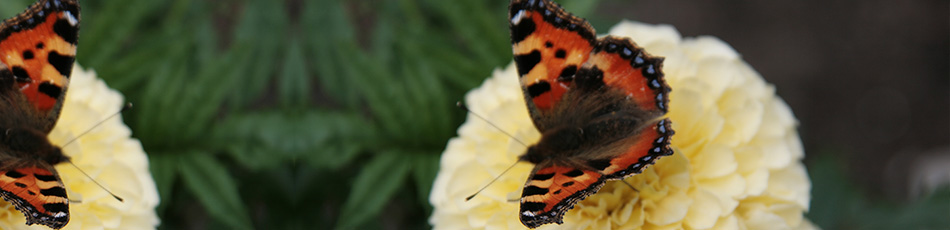
On the left in garden 24, you'll see a large eucalyptus. At the end of this path, you'll see the BUTTERFLY GARDEN on your right. The vegetation includes purple loosestrife, goldenrod, butterfly bushes, willowherb, and lavender. Here too, we rely on thriving species. The soil at Kweeklust contains, besides the age-old horsetail, also a great deal of bindweed (lily of the valley). While this produces beautiful white flowers in summer, it tends to overgrow all other plants. Walk along the woodchip path. Then turn left (p6) until you reach a V-junction (p7). Follow the left side and enter the rose arbor on the right. There, various types of roses climb up the wooden structure. In summer, you'll see a romantic cascade of small white roses: Guirlande d'Amour and the blood-red climbing rose Santana. You can also discover: American pillar (pink) and Paul's Himalaya musk (pink).
On the left, at the edge of garden 47, the branches of the Wymouth pine, rare in the Netherlands, with its long cones hanging over the path. Storm Eunice dislodged this tree in the spring of 2022, forcing us to top it, hoping to save this valuable tree.
Looking to the right, you'll see a small WADI, dug to store excess surface water and prevent flooded gardens. We've dug a second wadi, which is also doing its job well. The natural wall, loosely constructed of stones and shards, is ideal for rock plants and small creepers. Take a look at the large old crooked willow, an icon of Kweeklust. To its right, you'll see a tawny willow, a tree often found as a pollard willow in the surroundings.
Go around the crooked willow to the left and walk around the PEAT POND. Frogs, salamanders, dragonflies, water scorpions, and water beetles live there. If you sit on one of the benches, you'll see one of our compost heaps in the bushes on the left, where the waste from the general green area is composting. While you're there, you might hear plenty bird song. Kweeklust is a bird paradise. There are long-tailed tits, blackbirds, great tits, song thrushes, robins, wrens, treecreepers, long-eared owls, goldfinches, greenfinches, woodpeckers, kingfishers, dunnocks, woodcocks, and the white wagtail has also been spotted.
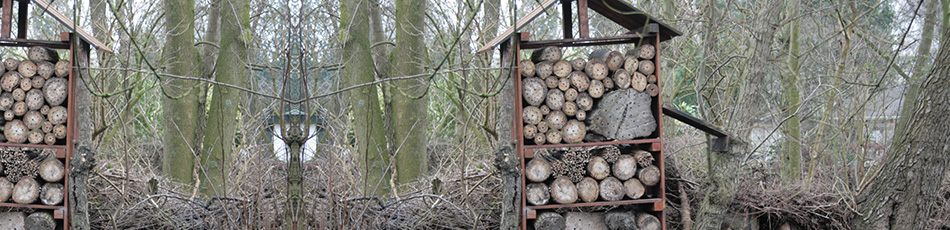
Leave the pond via the path between the two small trees (Catalpas). Straight ahead (over the canal) is the BIRD ISLAND. Turn left (p8). You'll walk under the rustling branches of a monumental weeping willow. After the small bridge, you'll see the PLAYGROUND straight ahead, with a velvet tree on the corner. On the right side of the border stands a beautiful silver birch tree, its bark providing shelter for many insect species. Make a small side step onto the wood chip path. From the bench, you can enjoy the view over the water; if you're lucky, you might see kingfishers skimming the water's surface. Back on the main path, at the junction, keep right (p. 9). Standing on the small bridge, you'll see an insect hotel and a beehive on your right. Take the first path on the right (p. 10), Eksterlaan. Along the right side is a long green strip, part of our general green space. On the left (next to garden 81) you'll see our soup garden with a small experimental part, recognizable by the greenhouse and growing beds. The harvest is used in the soup served after the general work sessions on Saturday mornings. Take a quick look to the right at the large Atlas cedar and turn left (p. 11).
Turn right at the T crossing (p. 12). Cabin 95 dates back to the early days of Kweeklust (1936). It's the smallest house in Kweeklust, with a huge weeping willow in the garden. Follow the path, which curves to the right. On the left, before the bridge, stands a Swedish Rowan tree, whose leaf shape differs from that of the common Rowan, but whose berries are just as beloved, especially by blackbirds. The curve continues. Take the first path on the left to leave Kweeklust (p. 13). Here you enter the Tuinwijck allotment garden. If you want to return to the entrance of Kweeklust, walk down Eksterlaan along the aforementioned Atlas Cedar. At the end, turn right-left. You'll then be back at the parking lot. You can take a rest on the bench near the small meadow on the left along the way. Feel free to come back. Kweeklust is beautiful in any season. The canteen is open on Saturday mornings.
April 2026